Traditional view of the nature of humanity
- What is it that makes us human beings?
- What actions are appropriate for humans?
A creature
The traditional western worldview, which was shaped by the Christian Bible, was that humans are creatures – in other words, they were intentionally created by another.
Created by God
According to Genesis 1:26-29 God created human beings
in his own image,
in the image of God he created them;
male and female he created them. TNIV
Whilst this account stresses the equality of each gender, Genesis 2:4-25 goes on to describe how God first creates man from the dust and breathes life into him. He then places the man in the Garden of Eden (see Big ideas: Garden of Eden, Adam and Eve, ‘Second Adam'). In order to provide companionship for the man, animals and birds are then created and named by the man. Finally, God creates woman as a partner for the man. As a result of disobedience against God, woman is made subject to the man (Genesis 3:16) and a sense of authority and power within human relationships is introduced.
An ordered created world
The chain of being
 By the 16th century (when Shakespeare was writing), the universe was seen as a hierarchy, with God, the Creator, at the top. Everyone and everything else, having been made by God, was a ‘creature' of God:
- Next to God in the order of creation were the angelic spirits: there were thought to be nine orders, or ranks: Seraphs, Cherubs, Thrones, Principalities, Virtues, Powers, Dominions, Archangels, Angels.
- Below these spirits were human beings, who were thought to be unique in having both a body, like animals, but also a spirit (or soul).
- Below mankind came animals, having body but no soul; then plants; then stones.
In traditional Elizabethan imagery, humans were each seen as a miniature world (microcosm) which corresponded to the wider cosmos (macrocosm).
Spiritual soul and physical body
In medieval and early modern times, writers often described the body as a container for the soul, seeing the body as made of earth and the soul as a spirit trapped within it. This idea was partly derived from the Greek philosopher Plato, but also reflected the words of Genesis (see above).
Mortal and eternal
Death
Human life is mortal, that is, it inevitably ends with physical death. In Act II sc ii Hamlet describes a human as a ‘quintessence of dust', recalling the words from the service for the Burial of the Dead in the Book of Common Prayer:
‘earth to earth, ashes to ashes, dust to dust'.
The eternal soul
Christians believe that all human beings have a soul which is immortal and reflects something of being made in God's image. Despite the relative brevity of human life, according to Christian belief the soul actually only wants to spend a short time in the world: it would far sooner be back in heaven. This was because humans were made in the image of God and welcomed the chance to be reunited with him.
(For more information see Big ideas: Death and resurrection.)
Humankind in the image of God
What does it mean for humans to reflect the nature of God?
The grace of ordinary life
- A person reflects the Creator when they fulfil the potential they were created with
- There is grace in humbly serving others
- Humans were created to work using their abilities. A society that allows unemployment is a society that denies the image of God in people.
Human creativity
Some people think that human intelligence, for example as evidenced through language and through creative abilities, indicates something of humanity's divinely-given qualities. The Bible however, draws a clear distinction between God, the creator, and everything else in the universe – creation. The fact that humans are creative is simply a reflection of the image of God in human beings. Even the brightest human mind is limited by the search for a logical answer to what is beyond human comprehension.
Reason versus passion
Reason informs the soul of man, reflects the nature of God (though in earlier centuries it was not believed that God had need of discursive thought, as he is all knowing anyway) and makes humans higher than animals:
- Because people have a soul, they can aspire to reach beyond their body and mortality
- If they debase their soul, and lose their reason — especially through drunkenness or by giving way to extreme passion — then they are no better than animals.
Conscience and choice – free will
Much literature reflects that, like their maker, humans can make moral choices based on an understanding of right and wrong. From the Early Church onwards, the image of God was associated with freedom - Christians believe that God is free and that humanity participates in this. People are neither automatons nor simply driven by unconquerable instincts, but have free will.
Innocence and sin
The Genesis account
According to Genesis (the first book of the Bible), when God created humans he placed them in the Garden of Eden, sometimes known as ‘Paradise'. In this garden was the Tree of the Knowledge of Good and .jpg) Evil. The first two humans, Adam and Eve, were told by God that they could eat anything in the garden except the fruit of this tree.
Evil. The first two humans, Adam and Eve, were told by God that they could eat anything in the garden except the fruit of this tree.
Eve, the first woman, was tempted by a serpent (traditionally held to be the devil in the shape of a snake) who spoke to her, telling her that if they ate the fruit she and Adam would ‘be as gods, knowing good and evil' (Genesis 3:5). This was a lie, but the serpent induced Eve to eat. She and Adam were then for the first time aware of shame, and instead of being innocently naked they tried to make themselves clothes out of fig leaves.
All tainted
Once Eve had eaten the fruit, she offered some to Adam and he also ate some, disobeying God's command not to. Before this they had both been innocent. Now they had committed sin — an offence against the laws of God.
- As this is the first sin in the Bible, it is also known as ‘original sin'
- Since all human beings are, according to Genesis, descended from Adam and Eve, all humans share this ‘original sin'.
The descent from original innocence to sin, because of the actions of Adam and Eve, is also called ‘The Fall of humankind' or simply ‘The Fall'.
More on the Fall: Writers have sometimes depicted it as a physical fall down through the air, like the classical story of Icarus falling after trying to fly too high. It is referred to in this way, for example in Marlowe's Doctor Faustus and in James Joyce's A Portrait of the Artist As A Young Man.
For further information see Big ideas: Garden of Eden, Adam and Eve, ‘Second Adam'.
Hope for humankind
Christians believe that Jesus Christ ‘turned around' the effects of original sin and so it can be washed away by baptism into faith in Christ, and forgiven by the grace of God. (See Themes and significant ideas: Grace, Mercy and forgiveness.)
Free will
There is a huge debate as to how far individuals should be held accountable for their actions:
Natural and unnatural behaviour
Hamlet feels (Act I sc iv) that some people are born with defective characters:
‘So oft it chances in particular men,
That, for some vicious mole of nature in them,
As, in their birth – wherein they are not guilty,
Since nature cannot choose his origin — ….
Carrying, I say, the stamp of one defect, being nature's livery ...
Shall in the general censure take corruption
From that particular fault.'
i.e. it is in their ‘nature' to behave in such a way.
At the same time, behaving unnaturally, in a way that is below the level that should be appropriate for the nature of humans (see The Chain of being) makes people like animals: ‘A beast, no more.' (Hamlet Act IV sc iv)
Getting the balance right
In Measure for Measure, Shakespeare shows also us that it is possible to go to the other extreme. Those who forget that they are not angels, but instead have human weaknesses, are just as unaware of their own humanity as those who behave like animals.
Sexuality and procreation
Creation and new life
Part of human nature is sexual activity:
- Is sex merely sensual, involving no commitment?
- Should humans echo the behaviour of other creatures, which procreate purely by instinct?
or
- Is it an act which reflects the self-giving love of God and echoes his creativity?
Attitudes to sexual activity
- In the western Christian worldview, sexuality was only to be expressed within marriage, where vows were made in the presence of God
- Although there was inevitably sexual activity outside marriage, it was very much frowned upon, and the woman would usually be considered disgraced
- But in much literature, the arrival of a child is also described in terms which suggest it is a right and natural part of the creative process.
Judgement
Because the soul is believed by Christians to be eternal, and humans are accountable for the actions they have chosen during their lifetime on the basis of free will, there is a focus in the western tradition on the fate of humans after physical death.
The Last Judgement
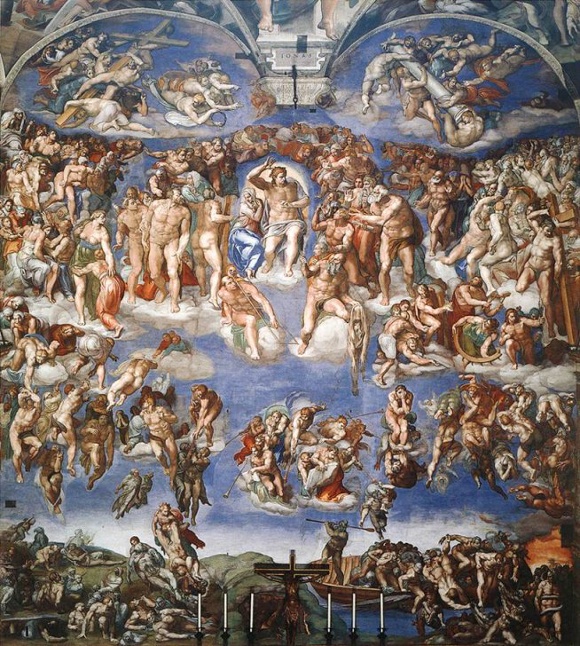 Many writers and artists have concentrated on depicting the Last Judgement. This is the biblical idea that, at the end of the world, all peoples will be judged before God. The Gospel of Matthew (Matthew 25:31-34) records Christ describing how,
‘when the
Son of Man comes in his
glory … all the nations will be gathered before him and he will separate the people one from another as a
shepherd separates the
sheep from the
goats. He will put the sheep on his right and the goats on his left'.
(See also Big ideas: Sheep, shepherd, lamb; Goats.)
Those on the right represent people who are faithful to God. They will be blessed and called into the eternal kingdom of God. Those on the left, who have rejected - or rebelled against - God, will be sent into the fires of hell. This vision was the subject of many medieval church paintings.
- English Standard Version
- King James Version
1In the beginning, God created the heavens and the earth. 2The earth was without form and void, and darkness was over the face of the deep. And the Spirit of God was hovering over the face of the waters. 3And God said, Let there be light, and there was light. 4And God saw that the light was good. And God separated the light from the darkness. 5God called the light Day, and the darkness he called Night. And there was evening and there was morning, the first day. 6And God said, Let there be an expanse in the midst of the waters, and let it separate the waters from the waters. 7And God made the expanse and separated the waters that were under the expanse from the waters that were above the expanse. And it was so. 8And God called the expanse Heaven. And there was evening and there was morning, the second day. 9And God said, Let the waters under the heavens be gathered together into one place, and let the dry land appear. And it was so. 10God called the dry land Earth, and the waters that were gathered together he called Seas. And God saw that it was good. 11And God said, Let the earth sprout vegetation, plants yielding seed, and fruit trees bearing fruit in which is their seed, each according to its kind, on the earth. And it was so. 12The earth brought forth vegetation, plants yielding seed according to their own kinds, and trees bearing fruit in which is their seed, each according to its kind. And God saw that it was good. 13And there was evening and there was morning, the third day. 14And God said, Let there be lights in the expanse of the heavens to separate the day from the night. And let them be for signs and for seasons, and for days and years, 15and let them be lights in the expanse of the heavens to give light upon the earth. And it was so. 16And God made the two great lights - the greater light to rule the day and the lesser light to rule the night - and the stars. 17And God set them in the expanse of the heavens to give light on the earth, 18to rule over the day and over the night, and to separate the light from the darkness. And God saw that it was good. 19And there was evening and there was morning, the fourth day. 20And God said, Let the waters swarm with swarms of living creatures, and let birds fly above the earth across the expanse of the heavens. 21So God created the great sea creatures and every living creature that moves, with which the waters swarm, according to their kinds, and every winged bird according to its kind. And God saw that it was good. 22And God blessed them, saying, Be fruitful and multiply and fill the waters in the seas, and let birds multiply on the earth. 23And there was evening and there was morning, the fifth day. 24And God said, Let the earth bring forth living creatures according to their kinds - livestock and creeping things and beasts of the earth according to their kinds. And it was so. 25And God made the beasts of the earth according to their kinds and the livestock according to their kinds, and everything that creeps on the ground according to its kind. And God saw that it was good. 26Then God said, Let us make man in our image, after our likeness. And let them have dominion over the fish of the sea and over the birds of the heavens and over the livestock and over all the earth and over every creeping thing that creeps on the earth. 27So God created man in his own image, in the image of God he created him; male and female he created them. 28And God blessed them. And God said to them, Be fruitful and multiply and fill the earth and subdue it, and have dominion over the fish of the sea and over the birds of the heavens and over every living thing that moves on the earth. 29And God said, Behold, I have given you every plant yielding seed that is on the face of all the earth, and every tree with seed in its fruit. You shall have them for food. 30And to every beast of the earth and to every bird of the heavens and to everything that creeps on the earth, everything that has the breath of life, I have given every green plant for food. And it was so. 31And God saw everything that he had made, and behold, it was very good. And there was evening and there was morning, the sixth day.
1In the beginning God created the heaven and the earth. 2And the earth was without form, and void; and darkness was upon the face of the deep. And the Spirit of God moved upon the face of the waters. 3And God said, Let there be light: and there was light. 4And God saw the light, that it was good: and God divided the light from the darkness. 5And God called the light Day, and the darkness he called Night. And the evening and the morning were the first day. 6And God said, Let there be a firmament in the midst of the waters, and let it divide the waters from the waters. 7And God made the firmament, and divided the waters which were under the firmament from the waters which were above the firmament: and it was so. 8And God called the firmament Heaven. And the evening and the morning were the second day. 9And God said, Let the waters under the heaven be gathered together unto one place, and let the dry land appear: and it was so. 10And God called the dry land Earth; and the gathering together of the waters called he Seas: and God saw that it was good. 11And God said, Let the earth bring forth grass, the herb yielding seed, and the fruit tree yielding fruit after his kind, whose seed is in itself, upon the earth: and it was so. 12And the earth brought forth grass, and herb yielding seed after his kind, and the tree yielding fruit, whose seed was in itself, after his kind: and God saw that it was good. 13And the evening and the morning were the third day. 14And God said, Let there be lights in the firmament of the heaven to divide the day from the night; and let them be for signs, and for seasons, and for days, and years: 15And let them be for lights in the firmament of the heaven to give light upon the earth: and it was so. 16And God made two great lights; the greater light to rule the day, and the lesser light to rule the night: he made the stars also. 17And God set them in the firmament of the heaven to give light upon the earth, 18And to rule over the day and over the night, and to divide the light from the darkness: and God saw that it was good. 19And the evening and the morning were the fourth day. 20And God said, Let the waters bring forth abundantly the moving creature that hath life, and fowl that may fly above the earth in the open firmament of heaven. 21And God created great whales, and every living creature that moveth, which the waters brought forth abundantly, after their kind, and every winged fowl after his kind: and God saw that it was good. 22And God blessed them, saying, Be fruitful, and multiply, and fill the waters in the seas, and let fowl multiply in the earth. 23And the evening and the morning were the fifth day. 24And God said, Let the earth bring forth the living creature after his kind, cattle, and creeping thing, and beast of the earth after his kind: and it was so. 25And God made the beast of the earth after his kind, and cattle after their kind, and every thing that creepeth upon the earth after his kind: and God saw that it was good. 26And God said, Let us make man in our image, after our likeness: and let them have dominion over the fish of the sea, and over the fowl of the air, and over the cattle, and over all the earth, and over every creeping thing that creepeth upon the earth. 27So God created man in his own image, in the image of God created he him; male and female created he them. 28And God blessed them, and God said unto them, Be fruitful, and multiply, and replenish the earth, and subdue it: and have dominion over the fish of the sea, and over the fowl of the air, and over every living thing that moveth upon the earth. 29And God said, Behold, I have given you every herb bearing seed, which is upon the face of all the earth, and every tree, in the which is the fruit of a tree yielding seed; to you it shall be for meat. 30And to every beast of the earth, and to every fowl of the air, and to every thing that creepeth upon the earth, wherein there is life, I have given every green herb for meat: and it was so. 31And God saw every thing that he had made, and, behold, it was very good. And the evening and the morning were the sixth day.
- English Standard Version
- King James Version
1Thus the heavens and the earth were finished, and all the host of them. 2And on the seventh day God finished his work that he had done, and he rested on the seventh day from all his work that he had done. 3So God blessed the seventh day and made it holy, because on it God rested from all his work that he had done in creation. 4These are the generations of the heavens and the earth when they were created, in the day that the Lord God made the earth and the heavens. 5When no bush of the field was yet in the land and no small plant of the field had yet sprung up - for the Lord God had not caused it to rain on the land, and there was no man to work the ground, 6and a mist was going up from the land and was watering the whole face of the ground - 7then the Lord God formed the man of dust from the ground and breathed into his nostrils the breath of life, and the man became a living creature. 8And the Lord God planted a garden in Eden, in the east, and there he put the man whom he had formed. 9And out of the ground the Lord God made to spring up every tree that is pleasant to the sight and good for food. The tree of life was in the midst of the garden, and the tree of the knowledge of good and evil. 10A river flowed out of Eden to water the garden, and there it divided and became four rivers. 11The name of the first is the Pishon. It is the one that flowed around the whole land of Havilah, where there is gold. 12And the gold of that land is good; bdellium and onyx stone are there. 13The name of the second river is the Gihon. It is the one that flowed around the whole land of Cush. 14And the name of the third river is the Tigris, which flows east of Assyria. And the fourth river is the Euphrates. 15The Lord God took the man and put him in the garden of Eden to work it and keep it. 16And the Lord God commanded the man, saying, You may surely eat of every tree of the garden, 17but of the tree of the knowledge of good and evil you shall not eat, for in the day that you eat of it you shall surely die. 18Then the Lord God said, It is not good that the man should be alone; I will make him a helper fit for him. 19Now out of the ground the Lord God had formed every beast of the field and every bird of the heavens and brought them to the man to see what he would call them. And whatever the man called every living creature, that was its name. 20The man gave names to all livestock and to the birds of the heavens and to every beast of the field. But for Adam there was not found a helper fit for him. 21So the Lord God caused a deep sleep to fall upon the man, and while he slept took one of his ribs and closed up its place with flesh. 22And the rib that the Lord God had taken from the man he made into a woman and brought her to the man. 23Then the man said, This at last is bone of my bones and flesh of my flesh; she shall be called Woman, because she was taken out of Man. 24Therefore a man shall leave his father and his mother and hold fast to his wife, and they shall become one flesh. 25And the man and his wife were both naked and were not ashamed.
1Thus the heavens and the earth were finished, and all the host of them. 2And on the seventh day God ended his work which he had made; and he rested on the seventh day from all his work which he had made. 3And God blessed the seventh day, and sanctified it: because that in it he had rested from all his work which God created and made. 4These are the generations of the heavens and of the earth when they were created, in the day that the LORD God made the earth and the heavens, 5And every plant of the field before it was in the earth, and every herb of the field before it grew: for the LORD God had not caused it to rain upon the earth, and there was not a man to till the ground. 6But there went up a mist from the earth, and watered the whole face of the ground. 7And the LORD God formed man of the dust of the ground, and breathed into his nostrils the breath of life; and man became a living soul. 8And the LORD God planted a garden eastward in Eden; and there he put the man whom he had formed. 9And out of the ground made the LORD God to grow every tree that is pleasant to the sight, and good for food; the tree of life also in the midst of the garden, and the tree of knowledge of good and evil. 10And a river went out of Eden to water the garden; and from thence it was parted, and became into four heads. 11The name of the first is Pison: that is it which compasseth the whole land of Havilah, where there is gold; 12And the gold of that land is good: there is bdellium and the onyx stone. 13And the name of the second river is Gihon: the same is it that compasseth the whole land of Ethiopia. 14And the name of the third river is Hiddekel: that is it which goeth toward the east of Assyria. And the fourth river is Euphrates. 15And the LORD God took the man, and put him into the garden of Eden to dress it and to keep it. 16And the LORD God commanded the man, saying, Of every tree of the garden thou mayest freely eat: 17But of the tree of the knowledge of good and evil, thou shalt not eat of it: for in the day that thou eatest thereof thou shalt surely die. 18And the LORD God said, It is not good that the man should be alone; I will make him an help meet for him. 19And out of the ground the LORD God formed every beast of the field, and every fowl of the air; and brought them unto Adam to see what he would call them: and whatsoever Adam called every living creature, that was the name thereof. 20And Adam gave names to all cattle, and to the fowl of the air, and to every beast of the field; but for Adam there was not found an help meet for him. 21And the LORD God caused a deep sleep to fall upon Adam, and he slept: and he took one of his ribs, and closed up the flesh instead thereof; 22And the rib, which the LORD God had taken from man, made he a woman, and brought her unto the man. 23And Adam said, This is now bone of my bones, and flesh of my flesh: she shall be called Woman, because she was taken out of Man. 24Therefore shall a man leave his father and his mother, and shall cleave unto his wife: and they shall be one flesh. 25And they were both naked, the man and his wife, and were not ashamed.
- English Standard Version
- King James Version
1Now the serpent was more crafty than any other beast of the field that the Lord God had made. He said to the woman, Did God actually say, You shall not eat of any tree in the garden? 2And the woman said to the serpent, We may eat of the fruit of the trees in the garden, 3but God said, You shall not eat of the fruit of the tree that is in the midst of the garden, neither shall you touch it, lest you die. 4But the serpent said to the woman, You will not surely die. 5For God knows that when you eat of it your eyes will be opened, and you will be like God, knowing good and evil. 6So when the woman saw that the tree was good for food, and that it was a delight to the eyes, and that the tree was to be desired to make one wise, she took of its fruit and ate, and she also gave some to her husband who was with her, and he ate. 7Then the eyes of both were opened, and they knew that they were naked. And they sewed fig leaves together and made themselves loincloths. 8And they heard the sound of the Lord God walking in the garden in the cool of the day, and the man and his wife hid themselves from the presence of the Lord God among the trees of the garden. 9But the Lord God called to the man and said to him, Where are you? 10And he said, I heard the sound of you in the garden, and I was afraid, because I was naked, and I hid myself. 11He said, Who told you that you were naked? Have you eaten of the tree of which I commanded you not to eat? 12The man said, The woman whom you gave to be with me, she gave me fruit of the tree, and I ate. 13Then the Lord God said to the woman, What is this that you have done? The woman said, The serpent deceived me, and I ate. 14The Lord God said to the serpent, Because you have done this, cursed are you above all livestock and above all beasts of the field; on your belly you shall go, and dust you shall eat all the days of your life. 15I will put enmity between you and the woman, and between your offspring and her offspring; he shall bruise your head, and you shall bruise his heel. 16To the woman he said, I will surely multiply your pain in childbearing; in pain you shall bring forth children. Your desire shall be for your husband, and he shall rule over you. 17And to Adam he said, Because you have listened to the voice of your wife and have eaten of the tree of which I commanded you, You shall not eat of it, cursed is the ground because of you; in pain you shall eat of it all the days of your life; 18thorns and thistles it shall bring forth for you; and you shall eat the plants of the field. 19By the sweat of your face you shall eat bread, till you return to the ground, for out of it you were taken; for you are dust, and to dust you shall return. 20The man called his wife's name Eve, because she was the mother of all living. 21And the Lord God made for Adam and for his wife garments of skins and clothed them. 22Then the Lord God said, Behold, the man has become like one of us in knowing good and evil. Now, lest he reach out his hand and take also of the tree of life and eat, and live forever - 23therefore the Lord God sent him out from the garden of Eden to work the ground from which he was taken. 24He drove out the man, and at the east of the garden of Eden he placed the cherubim and a flaming sword that turned every way to guard the way to the tree of life.
1Now the serpent was more subtil than any beast of the field which the LORD God had made. And he said unto the woman, Yea, hath God said, Ye shall not eat of every tree of the garden? 2And the woman said unto the serpent, We may eat of the fruit of the trees of the garden: 3But of the fruit of the tree which is in the midst of the garden, God hath said, Ye shall not eat of it, neither shall ye touch it, lest ye die. 4And the serpent said unto the woman, Ye shall not surely die: 5For God doth know that in the day ye eat thereof, then your eyes shall be opened, and ye shall be as gods, knowing good and evil. 6And when the woman saw that the tree was good for food, and that it was pleasant to the eyes, and a tree to be desired to make one wise, she took of the fruit thereof, and did eat, and gave also unto her husband with her; and he did eat. 7And the eyes of them both were opened, and they knew that they were naked; and they sewed fig leaves together, and made themselves aprons. 8And they heard the voice of the LORD God walking in the garden in the cool of the day: and Adam and his wife hid themselves from the presence of the LORD God amongst the trees of the garden. 9And the LORD God called unto Adam, and said unto him, Where art thou? 10And he said, I heard thy voice in the garden, and I was afraid, because I was naked; and I hid myself. 11And he said, Who told thee that thou wast naked? Hast thou eaten of the tree, whereof I commanded thee that thou shouldest not eat? 12And the man said, The woman whom thou gavest to be with me, she gave me of the tree, and I did eat. 13And the LORD God said unto the woman, What is this that thou hast done? And the woman said, The serpent beguiled me, and I did eat. 14And the LORD God said unto the serpent, Because thou hast done this, thou art cursed above all cattle, and above every beast of the field; upon thy belly shalt thou go, and dust shalt thou eat all the days of thy life: 15And I will put enmity between thee and the woman, and between thy seed and her seed; it shall bruise thy head, and thou shalt bruise his heel. 16Unto the woman he said, I will greatly multiply thy sorrow and thy conception; in sorrow thou shalt bring forth children; and thy desire shall be to thy husband, and he shall rule over thee. 17And unto Adam he said, Because thou hast hearkened unto the voice of thy wife, and hast eaten of the tree, of which I commanded thee, saying, Thou shalt not eat of it: cursed is the ground for thy sake; in sorrow shalt thou eat of it all the days of thy life; 18Thorns also and thistles shall it bring forth to thee; and thou shalt eat the herb of the field; 19In the sweat of thy face shalt thou eat bread, till thou return unto the ground; for out of it wast thou taken: for dust thou art, and unto dust shalt thou return. 20And Adam called his wife's name Eve; because she was the mother of all living. 21Unto Adam also and to his wife did the LORD God make coats of skins, and clothed them. 22And the LORD God said, Behold, the man is become as one of us, to know good and evil: and now, lest he put forth his hand, and take also of the tree of life, and eat, and live for ever: 23Therefore the LORD God sent him forth from the garden of Eden, to till the ground from whence he was taken. 24So he drove out the man; and he placed at the east of the garden of Eden Cherubims, and a flaming sword which turned every way, to keep the way of the tree of life.
- English Standard Version
- King James Version
1Now the serpent was more crafty than any other beast of the field that the Lord God had made. He said to the woman, Did God actually say, You shall not eat of any tree in the garden? 2And the woman said to the serpent, We may eat of the fruit of the trees in the garden, 3but God said, You shall not eat of the fruit of the tree that is in the midst of the garden, neither shall you touch it, lest you die. 4But the serpent said to the woman, You will not surely die. 5For God knows that when you eat of it your eyes will be opened, and you will be like God, knowing good and evil. 6So when the woman saw that the tree was good for food, and that it was a delight to the eyes, and that the tree was to be desired to make one wise, she took of its fruit and ate, and she also gave some to her husband who was with her, and he ate. 7Then the eyes of both were opened, and they knew that they were naked. And they sewed fig leaves together and made themselves loincloths. 8And they heard the sound of the Lord God walking in the garden in the cool of the day, and the man and his wife hid themselves from the presence of the Lord God among the trees of the garden. 9But the Lord God called to the man and said to him, Where are you? 10And he said, I heard the sound of you in the garden, and I was afraid, because I was naked, and I hid myself. 11He said, Who told you that you were naked? Have you eaten of the tree of which I commanded you not to eat? 12The man said, The woman whom you gave to be with me, she gave me fruit of the tree, and I ate. 13Then the Lord God said to the woman, What is this that you have done? The woman said, The serpent deceived me, and I ate. 14The Lord God said to the serpent, Because you have done this, cursed are you above all livestock and above all beasts of the field; on your belly you shall go, and dust you shall eat all the days of your life. 15I will put enmity between you and the woman, and between your offspring and her offspring; he shall bruise your head, and you shall bruise his heel. 16To the woman he said, I will surely multiply your pain in childbearing; in pain you shall bring forth children. Your desire shall be for your husband, and he shall rule over you. 17And to Adam he said, Because you have listened to the voice of your wife and have eaten of the tree of which I commanded you, You shall not eat of it, cursed is the ground because of you; in pain you shall eat of it all the days of your life; 18thorns and thistles it shall bring forth for you; and you shall eat the plants of the field. 19By the sweat of your face you shall eat bread, till you return to the ground, for out of it you were taken; for you are dust, and to dust you shall return. 20The man called his wife's name Eve, because she was the mother of all living. 21And the Lord God made for Adam and for his wife garments of skins and clothed them. 22Then the Lord God said, Behold, the man has become like one of us in knowing good and evil. Now, lest he reach out his hand and take also of the tree of life and eat, and live forever - 23therefore the Lord God sent him out from the garden of Eden to work the ground from which he was taken. 24He drove out the man, and at the east of the garden of Eden he placed the cherubim and a flaming sword that turned every way to guard the way to the tree of life.
1Now the serpent was more subtil than any beast of the field which the LORD God had made. And he said unto the woman, Yea, hath God said, Ye shall not eat of every tree of the garden? 2And the woman said unto the serpent, We may eat of the fruit of the trees of the garden: 3But of the fruit of the tree which is in the midst of the garden, God hath said, Ye shall not eat of it, neither shall ye touch it, lest ye die. 4And the serpent said unto the woman, Ye shall not surely die: 5For God doth know that in the day ye eat thereof, then your eyes shall be opened, and ye shall be as gods, knowing good and evil. 6And when the woman saw that the tree was good for food, and that it was pleasant to the eyes, and a tree to be desired to make one wise, she took of the fruit thereof, and did eat, and gave also unto her husband with her; and he did eat. 7And the eyes of them both were opened, and they knew that they were naked; and they sewed fig leaves together, and made themselves aprons. 8And they heard the voice of the LORD God walking in the garden in the cool of the day: and Adam and his wife hid themselves from the presence of the LORD God amongst the trees of the garden. 9And the LORD God called unto Adam, and said unto him, Where art thou? 10And he said, I heard thy voice in the garden, and I was afraid, because I was naked; and I hid myself. 11And he said, Who told thee that thou wast naked? Hast thou eaten of the tree, whereof I commanded thee that thou shouldest not eat? 12And the man said, The woman whom thou gavest to be with me, she gave me of the tree, and I did eat. 13And the LORD God said unto the woman, What is this that thou hast done? And the woman said, The serpent beguiled me, and I did eat. 14And the LORD God said unto the serpent, Because thou hast done this, thou art cursed above all cattle, and above every beast of the field; upon thy belly shalt thou go, and dust shalt thou eat all the days of thy life: 15And I will put enmity between thee and the woman, and between thy seed and her seed; it shall bruise thy head, and thou shalt bruise his heel. 16Unto the woman he said, I will greatly multiply thy sorrow and thy conception; in sorrow thou shalt bring forth children; and thy desire shall be to thy husband, and he shall rule over thee. 17And unto Adam he said, Because thou hast hearkened unto the voice of thy wife, and hast eaten of the tree, of which I commanded thee, saying, Thou shalt not eat of it: cursed is the ground for thy sake; in sorrow shalt thou eat of it all the days of thy life; 18Thorns also and thistles shall it bring forth to thee; and thou shalt eat the herb of the field; 19In the sweat of thy face shalt thou eat bread, till thou return unto the ground; for out of it wast thou taken: for dust thou art, and unto dust shalt thou return. 20And Adam called his wife's name Eve; because she was the mother of all living. 21Unto Adam also and to his wife did the LORD God make coats of skins, and clothed them. 22And the LORD God said, Behold, the man is become as one of us, to know good and evil: and now, lest he put forth his hand, and take also of the tree of life, and eat, and live for ever: 23Therefore the LORD God sent him forth from the garden of Eden, to till the ground from whence he was taken. 24So he drove out the man; and he placed at the east of the garden of Eden Cherubims, and a flaming sword which turned every way, to keep the way of the tree of life.
- English Standard Version
- King James Version
1Then the kingdom of heaven will be like ten virgins who took their lamps and went to meet the bridegroom. 2Five of them were foolish, and five were wise. 3For when the foolish took their lamps, they took no oil with them, 4but the wise took flasks of oil with their lamps. 5As the bridegroom was delayed, they all became drowsy and slept. 6But at midnight there was a cry, Here is the bridegroom! Come out to meet him. 7Then all those virgins rose and trimmed their lamps. 8And the foolish said to the wise, Give us some of your oil, for our lamps are going out. 9But the wise answered, saying, Since there will not be enough for us and for you, go rather to the dealers and buy for yourselves. 10And while they were going to buy, the bridegroom came, and those who were ready went in with him to the marriage feast, and the door was shut. 11Afterward the other virgins came also, saying, Lord, lord, open to us. 12But he answered, Truly, I say to you, I do not know you. 13Watch therefore, for you know neither the day nor the hour. 14For it will be like a man going on a journey, who called his servants and entrusted to them his property. 15To one he gave five talents, to another two, to another one, to each according to his ability. Then he went away. 16He who had received the five talents went at once and traded with them, and he made five talents more. 17So also he who had the two talents made two talents more. 18But he who had received the one talent went and dug in the ground and hid his master's money. 19Now after a long time the master of those servants came and settled accounts with them. 20And he who had received the five talents came forward, bringing five talents more, saying, Master, you delivered to me five talents; here I have made five talents more. 21His master said to him, Well done, good and faithful servant. You have been faithful over a little; I will set you over much. Enter into the joy of your master. 22And he also who had the two talents came forward, saying, Master, you delivered to me two talents; here I have made two talents more. 23His master said to him, Well done, good and faithful servant. You have been faithful over a little; I will set you over much. Enter into the joy of your master. 24He also who had received the one talent came forward, saying, Master, I knew you to be a hard man, reaping where you did not sow, and gathering where you scattered no seed, 25so I was afraid, and I went and hid your talent in the ground. Here you have what is yours. 26But his master answered him, You wicked and slothful servant! You knew that I reap where I have not sown and gather where I scattered no seed? 27Then you ought to have invested my money with the bankers, and at my coming I should have received what was my own with interest. 28So take the talent from him and give it to him who has the ten talents. 29For to everyone who has will more be given, and he will have an abundance. But from the one who has not, even what he has will be taken away. 30And cast the worthless servant into the outer darkness. In that place there will be weeping and gnashing of teeth. 31When the Son of Man comes in his glory, and all the angels with him, then he will sit on his glorious throne. 32Before him will be gathered all the nations, and he will separate people one from another as a shepherd separates the sheep from the goats. 33And he will place the sheep on his right, but the goats on the left. 34Then the King will say to those on his right, Come, you who are blessed by my Father, inherit the kingdom prepared for you from the foundation of the world. 35For I was hungry and you gave me food, I was thirsty and you gave me drink, I was a stranger and you welcomed me, 36I was naked and you clothed me, I was sick and you visited me, I was in prison and you came to me. 37Then the righteous will answer him, saying, Lord, when did we see you hungry and feed you, or thirsty and give you drink? 38And when did we see you a stranger and welcome you, or naked and clothe you? 39And when did we see you sick or in prison and visit you? 40And the King will answer them, Truly, I say to you, as you did it to one of the least of these my brothers, you did it to me. 41Then he will say to those on his left, Depart from me, you cursed, into the eternal fire prepared for the devil and his angels. 42For I was hungry and you gave me no food, I was thirsty and you gave me no drink, 43I was a stranger and you did not welcome me, naked and you did not clothe me, sick and in prison and you did not visit me. 44Then they also will answer, saying, Lord, when did we see you hungry or thirsty or a stranger or naked or sick or in prison, and did not minister to you? 45Then he will answer them, saying, Truly, I say to you, as you did not do it to one of the least of these, you did not do it to me. 46And these will go away into eternal punishment, but the righteous into eternal life.
1Then shall the kingdom of heaven be likened unto ten virgins, which took their lamps, and went forth to meet the bridegroom. 2And five of them were wise, and five were foolish. 3They that were foolish took their lamps, and took no oil with them: 4But the wise took oil in their vessels with their lamps. 5While the bridegroom tarried, they all slumbered and slept. 6And at midnight there was a cry made, Behold, the bridegroom cometh; go ye out to meet him. 7Then all those virgins arose, and trimmed their lamps. 8And the foolish said unto the wise, Give us of your oil; for our lamps are gone out. 9But the wise answered, saying, Not so; lest there be not enough for us and you: but go ye rather to them that sell, and buy for yourselves. 10And while they went to buy, the bridegroom came; and they that were ready went in with him to the marriage: and the door was shut. 11Afterward came also the other virgins, saying, Lord, Lord, open to us. 12But he answered and said, Verily I say unto you, I know you not. 13Watch therefore, for ye know neither the day nor the hour wherein the Son of man cometh. 14For the kingdom of heaven is as a man travelling into a far country, who called his own servants, and delivered unto them his goods. 15And unto one he gave five talents, to another two, and to another one; to every man according to his several ability; and straightway took his journey. 16Then he that had received the five talents went and traded with the same, and made them other five talents. 17And likewise he that had received two, he also gained other two. 18But he that had received one went and digged in the earth, and hid his lord's money. 19After a long time the lord of those servants cometh, and reckoneth with them. 20And so he that had received five talents came and brought other five talents, saying, Lord, thou deliveredst unto me five talents: behold, I have gained beside them five talents more. 21His lord said unto him, Well done, thou good and faithful servant: thou hast been faithful over a few things, I will make thee ruler over many things: enter thou into the joy of thy lord. 22He also that had received two talents came and said, Lord, thou deliveredst unto me two talents: behold, I have gained two other talents beside them. 23His lord said unto him, Well done, good and faithful servant; thou hast been faithful over a few things, I will make thee ruler over many things: enter thou into the joy of thy lord. 24Then he which had received the one talent came and said, Lord, I knew thee that thou art an hard man, reaping where thou hast not sown, and gathering where thou hast not strawed: 25And I was afraid, and went and hid thy talent in the earth: lo, there thou hast that is thine. 26His lord answered and said unto him, Thou wicked and slothful servant, thou knewest that I reap where I sowed not, and gather where I have not strawed: 27Thou oughtest therefore to have put my money to the exchangers, and then at my coming I should have received mine own with usury. 28Take therefore the talent from him, and give it unto him which hath ten talents. 29For unto every one that hath shall be given, and he shall have abundance: but from him that hath not shall be taken away even that which he hath. 30And cast ye the unprofitable servant into outer darkness: there shall be weeping and gnashing of teeth. 31When the Son of man shall come in his glory, and all the holy angels with him, then shall he sit upon the throne of his glory: 32And before him shall be gathered all nations: and he shall separate them one from another, as a shepherd divideth his sheep from the goats: 33And he shall set the sheep on his right hand, but the goats on the left. 34Then shall the King say unto them on his right hand, Come, ye blessed of my Father, inherit the kingdom prepared for you from the foundation of the world: 35For I was an hungred, and ye gave me meat: I was thirsty, and ye gave me drink: I was a stranger, and ye took me in: 36Naked, and ye clothed me: I was sick, and ye visited me: I was in prison, and ye came unto me. 37Then shall the righteous answer him, saying, Lord, when saw we thee an hungred, and fed thee? or thirsty, and gave thee drink? 38When saw we thee a stranger, and took thee in? or naked, and clothed thee? 39Or when saw we thee sick, or in prison, and came unto thee? 40And the King shall answer and say unto them, Verily I say unto you, Inasmuch as ye have done it unto one of the least of these my brethren, ye have done it unto me. 41Then shall he say also unto them on the left hand, Depart from me, ye cursed, into everlasting fire, prepared for the devil and his angels: 42For I was an hungred, and ye gave me no meat: I was thirsty, and ye gave me no drink: 43I was a stranger, and ye took me not in: naked, and ye clothed me not: sick, and in prison, and ye visited me not. 44Then shall they also answer him, saying, Lord, when saw we thee an hungred, or athirst, or a stranger, or naked, or sick, or in prison, and did not minister unto thee? 45Then shall he answer them, saying, Verily I say unto you, Inasmuch as ye did it not to one of the least of these, ye did it not to me. 46And these shall go away into everlasting punishment: but the righteous into life eternal.
Name originally given to disciples of Jesus by outsiders and gradually adopted by the Early Church.
The Christian Bible consists of the Old Testament scriptures inherited from Judaism, together with the New Testament, drawn from writings produced from c.40-125CE, which describe the life of Jesus and the establishment of the Christian church.
The Bible describes God as the unique supreme being, creator and ruler of the universe.
Symbolic in the Bible of human mortality, echoed in the Anglican funeral service ('ashes to ashes, dust to dust').
The place described in the Book of Genesis in the Old Testament, in which God placed his first human creatures, Adam and Eve.
A body of persons or things ranked in grades, orders, or classes. Used specifically of the 'Nine orders of angels'.
The animate beings 'angels, humans, animals ' made by God.
Supernatural beings closely linked with the work of God; his messengers, traditionally portrayed as having a winged human form.
A non-physical being, or the non-physical but vital and intelligent part of a being, not limited by physical constraints.
Chief angel. In Christian tradition Michael, Gabriel and Raphael are considered to be archangels.
The spirit which gives life to a human being; the part which lives on after death; a person's inner being (personality, intellect, emotions and will) which distinguishes them from animals.
The little world, human beings and their inner world, often seen as paralleling the macrocosm.
The bigger world or cosmos. Anything from a planet to the whole universe.
A person who studies or is educated in philosophy.
The book of prayers and church services first put together by Thomas Cranmer, Archbishop of Canterbury in the time of King Edward VI (1547-53) for common (ie. general) use in English churches.
Name originally given to disciples of Jesus by outsiders and gradually adopted by the Early Church.
Term used to describe the first centuries of the growth of the Christian church, initially in Jerusalem and then across the Roman Empire.
According to the Book of Genesis, the Tree of the Knowledge of Good and Evil grew in the Garden of Eden. Adam and Eve were forbidden to eat its fruit by God. When they disobeyed, they lost their innocence and close relationship with God.
The opposite of goodness; thoughts and actions which are in opposition to God's will and result in wrongdoing and harm. That which opposes God.
According to Genesis (the first book of the Old Testament), Adam is the first human being, made in the image / likeness of God, placed in the Garden of Eden and given dominion over the earth.
According to the book of Genesis in the Bible the first woman, said to have been created by God out of Adam's rib, to be his companion.
A snake. In some religions and mythologies seen as the embodiment of deceit, cunning and evil, and associated with Satan.
Also known as Satan or Lucifer, the Bible depicts him as the chief of the fallen angels and demons, the arch enemy of God who mounts a significant, but ultimately futile, challenge to God's authority.
Literally, not 'nocent' or harmful. The term which is usually used nowadays to mean 'not guilty' of a crime, is often used in the Bible and literature to mean 'pure', 'free from sin'.
Disobedience to the known will of God. According to Christian theology human beings have displayed a pre-disposition to sin since the Fall of Humankind.
State of disobedience to - and alienation from - God believed to have characterised human beings since the Fall of Adam and Eve.
The disobedience of Adam and Eve in the Bible is known as the Fall of Humankind. Christians believe that humans from then on have had a a predispostion to disobey God.
Icarus - the son of Daedalus who died in the first flying accident.
(c. 4 BCE- c. 30 CE). The founder of Christianity, whose life and teaching are described and interpreted in the New Testament. Jesus is the Greek form of the Hebrew 'Joshua'. He was also given the title 'Christ', meaning 'anointed one' or 'Messiah'.
The immersion in or pouring over of water, in the name of God the Father, Son and Holy Spirit, to signify the washing away of away of sin. Baptism in Christian churches marks the acceptance of the baptised child or adult into the church.
1. The action of forgiving; pardon of a fault, remission of a debt.
2. Being freed from the burden of guilt, after committing a sin or crime, through being pardoned by the one hurt or offended.
Undeserved favour. The Bible uses this term to describe God's gifts to human beings.
The final judgement on humankind when all will have to give account of their lives to Christ as Judge.
Gospel - Literally 'good news' - used of the message preached by Jesus recorded in the New Testament.
1. The central message of the Christian faith
2. Title given to the four New Testament books which describe the life of Jesus Christ
A phrase from the Book of Daniel which describes 'one like a son of man' coming on the clouds of heaven and being given dominion over all peoples and nations. Jesus is shown using this phrase of himself in the Gospels.
1. Radiant beauty or splendour
2. Praise and honour given to God.
Sheep were a key part of the the economy in biblical times and the familiar figure of the shepherd occurs frequently in the Bible to signify leadership, and care. Jesus described himself as the Good Shepherd.
The Bible is full of images of sheep and shepherds, which have permeated Western literary traditions and culture.
In the Bible goats are often associated with sin and the need for forgiveness.
The receiving of divine favour by God (Genesis 1:22) which can be in material or spiritual terms.
Lasting forever, throughout all ages.
Kingdom of God (also called the Kingdom of Heaven). The central theme in the teaching of Jesus. Refers to God's rule and power at work among people who accept his authority in their lives.
1.Used in the Bible as a symbol of the presence of God.
2. Also associated with judgement and punishment.
3. Associated with purification
Jesus describes hell as the place where Satan and his demons reside and the realm where unrepentant souls will go after the Last Judgement.
1. Term for a worshipping community of Christians.
2. The building in which Christians traditionally meet for worship.
3. The worldwide community of Christian believers.

